New hires are an investment in future productivity.
Every hire starts as a promise. The team has a gap, a role that needs doing, work that's backing up, a manager covering for something they shouldn't have to cover for anymore. The new person arrives, and the gap is supposed to close. How long will that take?
In most organizations, the honest answer is longer than anyone planned for, and nobody really knows. The new hire spends their first weeks figuring out what nobody thought to tell them. The manager, already stretched, tries to bring them up to speed on top of their own job. The team keeps carrying the gap in the meantime. And the organization measures onboarding by whether the paperwork got completed, not by whether the gap actually closed.
Onboarding problems are usually treated as content problems, the handbook is out of date, the first week is a firehose, the checklist is long. But the underlying issues are structural.
What a deliberate onboarding system makes possible
· A faster, more predictable ramp. When you've defined what proficiency looks like at each stage and built the journey around the moments that actually bend the curve, new hires become independently useful sooner, and the variance narrows. The gap closes on a schedule instead of a hope.
Managers who aren't carrying it alone. A defined framework (with checkpoints, conversation guides, and clear expectations) gives managers a structure to run instead of an obligation to improvise. They stop being the bottleneck in closing the gap and start operating a system that closes it.
Consistency independent of who the manager is. A designed system gives every new hire a similar quality of experience, regardless of their manager's natural talent for onboarding. The gap closes at roughly the same rate, whoever is running the team.
Retention through the ramp. The first 90 days are when new hires decide whether they belong. A well-designed onboarding experience, one that builds confidence and connection early, is one of the most direct levers an organization has on early attrition. People who feel competent sooner are less likely to leave before they've contributed.
A system that scales. As the organization grows, onboarding that depends on individual effort breaks. A documented, templated, equipped system keeps closing gaps as headcount grows.
The through-line is that onboarding moves from something that happens to new hires and managers to something the organization runs on purpose.
How to build one
A successful onboarding experience requires more than good instructional materials. It needs a structured approach and coordinated operating system.
Structuring Your Approach
Diagnose and align. Establish clarity on what onboarding is meant to achieve, who owns which parts, and where the current approach breaks down.
Design for role readiness. Translate job expectations into structured learning paths that support performance, not just information transfer.
Build the experience and content framework. Design the structure, flow, and components of the onboarding experience so it's clear, manageable, and scalable.
Measure, hand off, and sustain. Ensure the program can be delivered consistently and improved over time, without external support.
The Coordinated Operating System
A good onboarding program has a deliberate progression. The employee should gradually move from orientation to supported practice, to independent performance. Onboarding systematically moves a new employee from being an outsider who doesn't know how things work to a confident, capable contributor who can perform their role independently and deliver meaningful results. Onboarding programs ask, “what should this person be able to do at the end of their first 30, 60, and 90 days?” Start with these resources:
Onboarding framework: Defines the overall experience and responsibilities
Role-based learning paths: Outlines expected milestones and proficiency
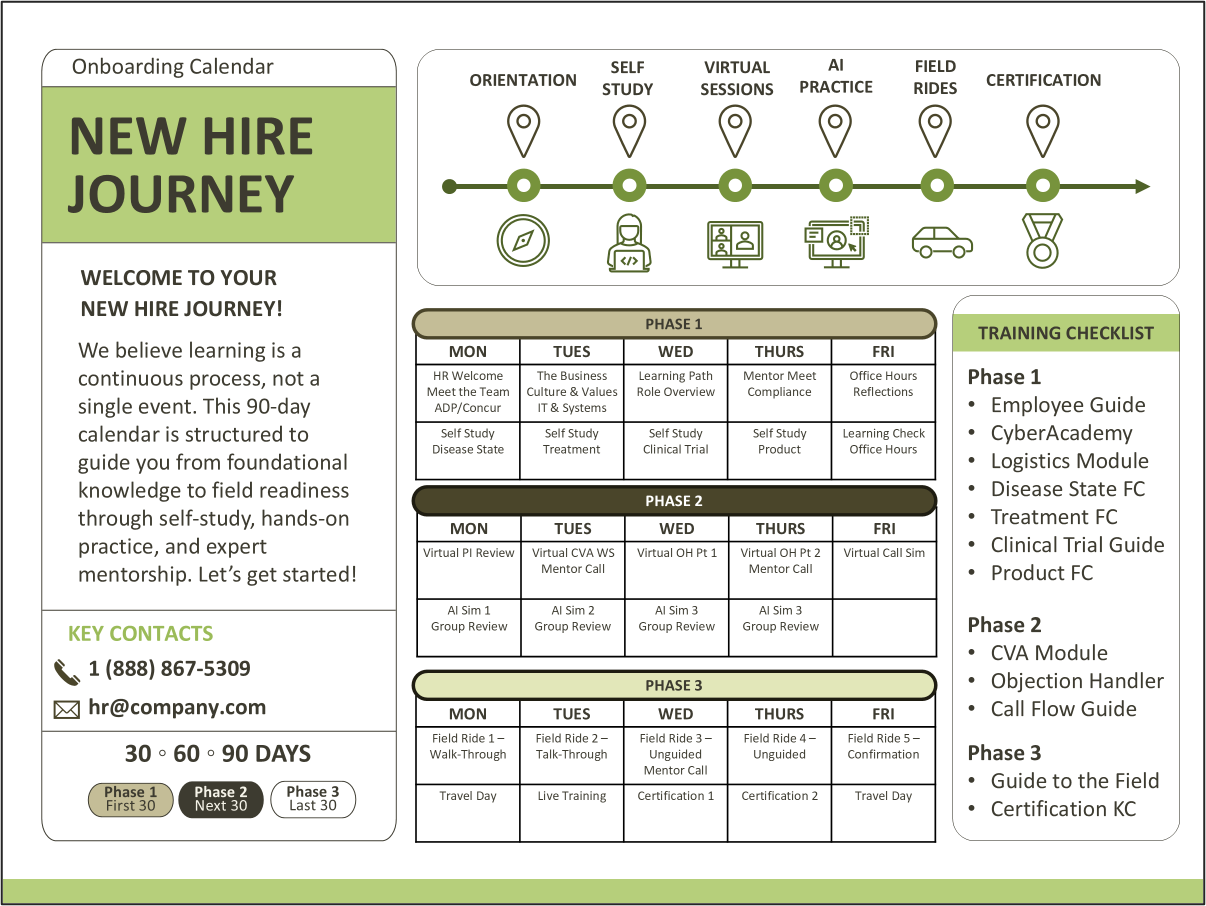
Onboarding calendar: Coordinates activities and learning experiences
Orientation guide: Introduces the business, structure, expectations, and culture
Learning resource library: Centralizes courses, videos, guides, and references
Progress tracker: Makes progress, milestones, and gaps visible
Mentor toolkit: Establishes peer support
Manager roadmap: Enables consistent manager-led onboarding
The learning and development team can design an excellent onboarding program, but the manager ultimately owns the employee's transition into the role.
If this is your problem
If your new hires take too long to actually fill the role they were hired for, if your managers are stretched thin trying to bring people up to speed on top of everything else, or if you suspect early attrition is telling you something about those first 90 days, the issue is usually the system, not the effort.