What would you do differently if L&D weren't a series of reactions?
Most organizations never get to answer that question.
Learning and development tends to happen to an organization rather than on purpose. A request arrives, a deadline appears, an engagement survey raises a flag, and the team responds. Programs get built in the order the urgency arrived. The result is usually competent, often well-liked, and rarely connected to a picture of where the organization is actually trying to go.
But ask a leadership team a different question: “What capability will this organization need in 12 months that it doesn't have today, and what's the plan to build it?” and something changes in the room. The conversation gets bigger. It moves from training to performance, from activity to strategy, from this quarter to the next three years. That conversation is the beginning of a Learning Strategy Blueprint.
What a deliberate approach makes possible
A learning strategy isn't a document about learning. It's a decision about what the organization is building toward, and it changes what becomes possible. Your learning strategy provides 4 things in particular:
A plan leaders can defend. When learning investment is tied to specific performance objectives, with explicit assumptions and constraints, the budget conversation changes. The question stops being "what are we spending on training?" and becomes "what are we buying, and what does it get us?" That's a defensible conversation, and it's a different one.
Appropriate resource allocation. A strategy establishes agreed priorities, which means time for training is eked out, budget exists, and leaders are committed to participating.
Alignment that's built in, not bolted on. Learning plans fail when leaders don't own the choices behind them. A deliberate process forces those choices into the open (where to invest, where to stop, and why) and pressure-tests them with the people the learning team is supporting. Alignment becomes a design feature rather than a final meeting.
Impact you can see and show. Measurement gets designed in from the start, not added afterward. The organization knows what "working" looks like before anything is created, which means it can see the results, and build on them.
What all 4 have in common is that they move learning from reacting to choosing. A plan that lets you choose deliberately, defensibly, and with your leadership aligned behind it, is worth more than any individual program it produces.
How to build one
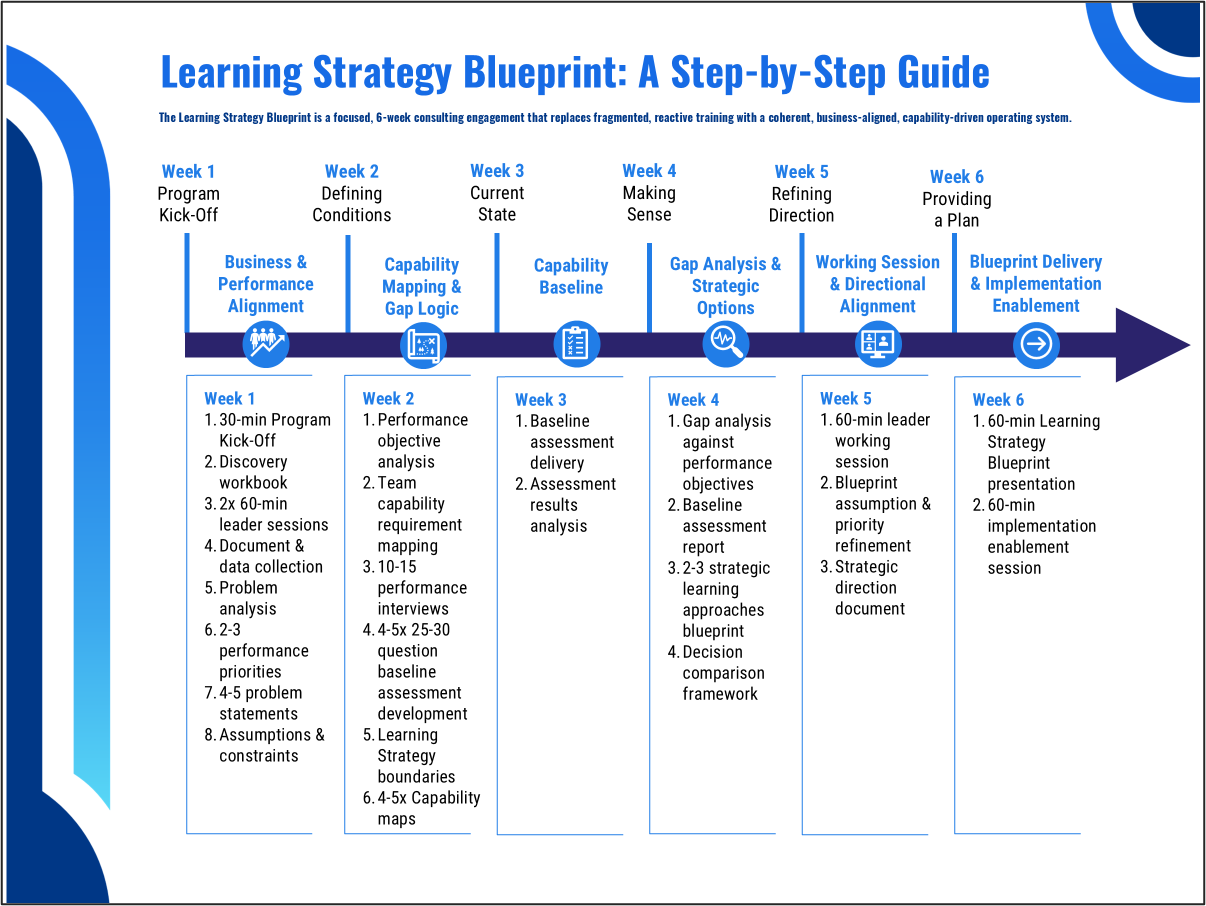
Building your learning strategy is a focused process, structured as a sequence of decisions. Each phase produces something the organization can use, and each narrows the choices until a deliberate, owned strategy emerges.
Align on the business. Start with what the business is trying to achieve over the next 12 months: goals, constraints, risks, and performance challenges. No skills lists. No solutions. Just clarity on where the organization is going, synthesized into 3–5 prioritized performance objectives.
Map capabilities and classify the gaps. For each objective, ask: what would need to be true for performance to improve? Map the capabilities required at the individual, team, and leadership levels. Classify the gaps: skill, process, system, structural.
Establish the baseline. Understand current capability before designing anything. Use scenario-based assessments or structured interviews with a representative sample of critical roles and leaders to identify where the performance gaps are happening.
Develop strategic options. Convert insight into choice. Develop 2–3 viable strategic approaches, each with its own trade-offs, risks, and dependencies; be clear enough that leadership can make a real decision rather than rubber-stamp a recommendation.
Pressure-test with stakeholders. Test the assumptions with the people who will be impacted by the plan. Refine priorities. Select a preferred direction. This is where the strategy stops being a proposal and becomes an owned activity.
Deliver the plan and enable implementation. Produce the action-ready Blueprint: A 12-month roadmap organized across onboarding, compliance, role-based capability, team effectiveness, and leadership development, and walk the execution teams through how to use it.
What it looks like when it works
The value isn't the plan itself. It's the shift from reacting to choosing, so the training that runs is the training that matters.
If this is your problem
If you've got a learning strategy that isn't changing anything and you've ever wondered what your L&D function could do with a real strategy behind it, think about where you want to be in 12 months, and what capability you'll need to get there.
If you want to learn, or do, more download the Learning Strategy Blueprint assets below. If you want to keep reading:
Click here to learn more about how Competency Mapping can help you execute steps 2 and 3.
Click here to learn more about the onboarding component of your learning strategy.
And click here to learn more about leadership development if that’s going to be a focus for you in the upcoming year.