Most competency frameworks sit in a drawer. The problem isn't the framework, it’s how it’s used once it’s developed—and waiting until it’s fully baked before you solve any meaningful business or performance problems.
If you've been through a competency mapping exercise, you probably remember it as a long list, a lot of meetings, and a document that got published and then quietly stopped mattering. Managers saw it as HR overhead. The business saw it as a delay. And the training that followed didn't change anything, because it was never connected to the map in the first place.
That experience is common, and it's reasonable to be wary of repeating it. But the conclusion most people draw ("competency mapping is bureaucracy") is the wrong lesson. The right lesson is that most competency mapping is done as bureaucracy: built from the top down, disconnected from real performance, and treated as an end in itself rather than the foundation for decisions.
Done as a foundation, it's the opposite of administrative overhead. It's what makes targeted action possible.
The real nature of the problem
The objection to competency mapping is usually about time and agility: we don't have months to spend on a framework; we need to act now. That objection is legitimate, and it's the reason the work has to be done deliberately rather than skipped. Because the alternative to a map isn't speed. It's churn.
Three things are true:
Without a map, every learning decision is a guess, and guesses compound. When you don't know which capabilities actually drive performance in a role, every request becomes a training project, every complaint becomes a course, and every urgent problem gets a program attached to it. The result isn't agility; it's a portfolio of reactive interventions that never quite close the gap, because nobody defined the gap in the first place. A map is what lets you say, with confidence, this is the priority and that isn't, which is the definition of agility.
Performance has to be mapped before it can be targeted. "Targeted" is the word that matters. A targeted intervention requires knowing three things: what good performance looks like, where current performance falls short, and which of those shortfalls are actually learning problems. Competency mapping is the mechanism that produces all three. Without it, you can be fast, but you can't be targeted—and untargeted speed is just expensive motion.
The map has to be built to serve decisions, not to be complete. This is where most mapping goes wrong. A mapping effort that tries to document every role exhaustively becomes the administrative burden people fear. A mapping effort built to support the next decision: which capabilities matter most, what good looks like, where the real gaps are, stays lean and earns its keep. The discipline is in deciding what not to map.
The deeper point is that this is the same principle as building a learning function. The function's North Star is a deliberate, systematized strategy—one that focuses on the right things, at the right time, and sees the big picture. Competency mapping is the instrument that makes that focus possible. It's not the strategy; it's what the strategy is built on.
A clear approach
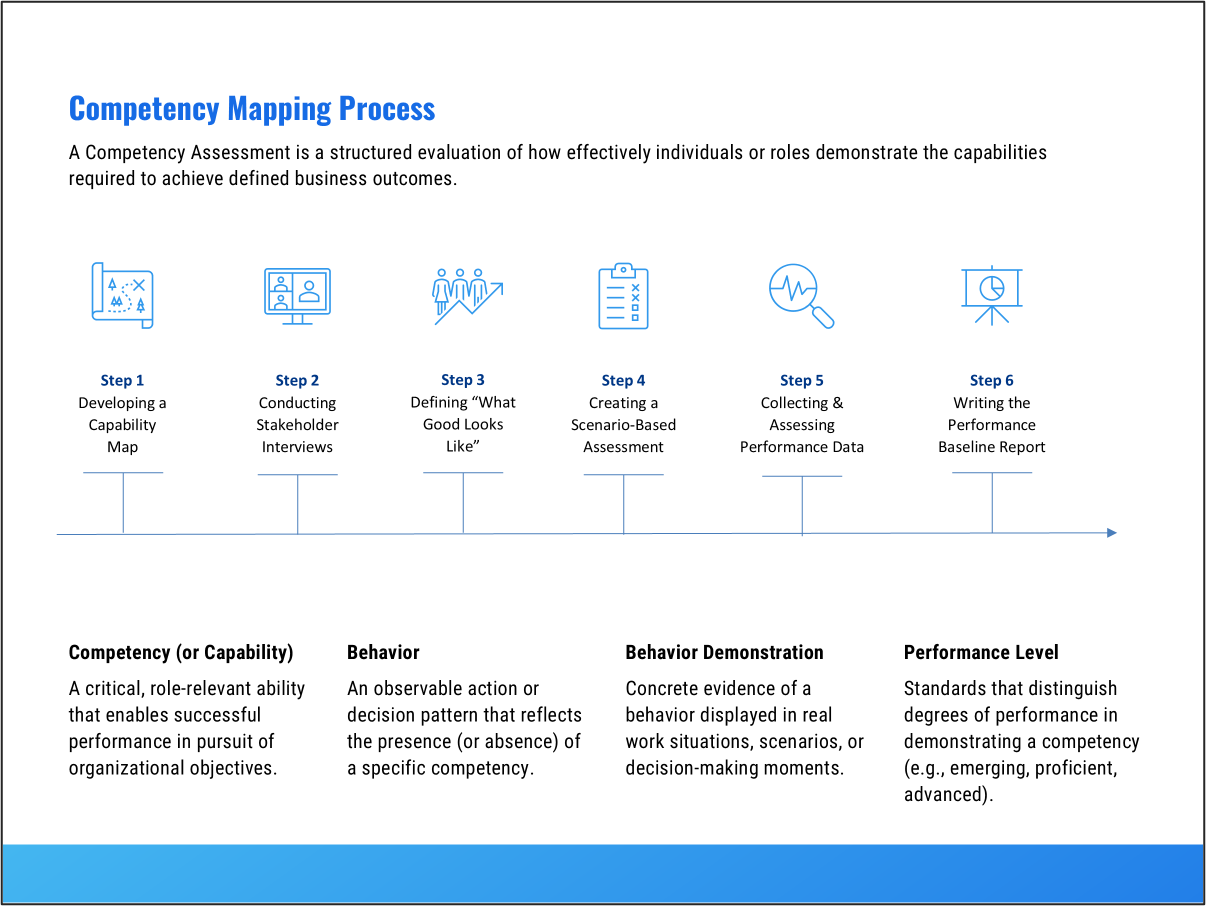
Competency Mapping moves through six steps, from mapping the capability to benchmarking the baseline. Each step produces a concrete artifact, and the sequence matters: you can't assess what you haven't defined, and you can't prioritize what you haven't measured.
Develop a capability map. Start with the work, not the trait list. For each role or role family, define the competencies the work actually requires, the observable behaviors that demonstrate each one, and the concrete demonstrations — real work situations where you'd see that behavior. This is the foundation: a map that connects competency → behavior → demonstration, so that everything downstream is measurable.
Conduct stakeholder interviews. Talk to the people doing the work and the people managing it. The questions are designed to surface the real shape of the role: what an average day, week, and quarter look like; what outcomes define success; where performance breaks down and why; what the hardest decisions are. This is where you find out what the competency map missed.
Define "what good looks like." For each competency, define the performance levels (typically emerging, proficient, and advanced) in observable terms. Not "demonstrates strong strategic thinking" but "makes trade-offs explicit, articulates downstream impact, and communicates reasoning to stakeholders." The standard has to be specific enough that two people could independently agree on a rating.
Create a scenario-based assessment. This is the distinctive step. Instead of self-report or manager rating, build realistic scenarios drawn from the stakeholder interviews; situations that require the person to prioritize, make trade-offs, or exercise judgment under ambiguity. Each scenario maps to a specific behavior and performance level, so responses can be assessed against the standard rather than against a gut feeling.
Collect and assess performance data. Run the assessment with a representative sample of the roles and leaders in scope. Focus on how work is actually done, how decisions are actually made, how problems are actually handled, not on how people describe themselves. Analyze patterns across roles and teams to find where capability is strong and where it's constrained.
Write the capability report and establish the baseline. Synthesize the findings into a report that does three things: establishes a realistic baseline of current performance, identifies the priority capability gaps, and defines the performance standards for critical roles. This is the artifact that makes the rest of the work defensible: a 12-month learning blueprint built on real data rather than assumptions.
The value in Competency Mapping isn't the framework document. It's the discipline of defining the standard before assessing it, assessing behavior rather than self-report, and classifying gaps before prescribing solutions; so that what gets built is targeted to address real business needs.
But wait, there’s more! Competency Mapping lays the foundation for you to create your annual training plan or Learning Strategy Blueprint, build effective onboarding, develop impactful coaching programs for strong leaders, and create role-based development pathways for continuous improvement.