Are you experiencing these problems?
Most organizations don't decide to build a learning function. They notice symptoms first.
You might be experiencing the problems below, that’s how you know it’s time to formalize learning in your organization:
Growth is outpacing organizational capability. You’re growing, entering new markets, launching new products, expanding services or taking on more complex work. But your people, processes and internal capabilities aren't necessarily keeping pace. The underlying problem is that growth requires new capabilities, but you haven’t yet established a systematic way to develop them.
Performance is inconsistent. You have clear business objectives, but achieving consistent results across teams, departments or locations is proving difficult. You keep having to address the same performance problems and deficiencies again and again. It feels like you’re always putting out fires. The gap here are clearly defined, established or reinforced capabilities and standards required for effective performance.
Leadership and management capability is underdeveloped. The organization relies heavily on its managers to drive performance, develop people and navigate change, but hasn't necessarily invested in equipping them to do so. If your leadership team isn’t driving the results you expect, it’s time to provide them the tools, and accountability, they need to build team capability.
Organizational knowledge is fragmented or at risk. Critical knowledge exists within the organization, but it isn't consistently captured, shared or transferred. You’ve outgrown your small, founder-led approach and need to develop culture, performance, and capability at scale to maintain quality standards and momentum.
Learning and development is reactive and disconnected from business priorities. Maybe you’re not seeing the ROI behind your training investment. You may already have learning programs, an LMS, compliance programs and even an L&D team. But there isn't a cohesive strategy connecting these activities to organizational priorities. Learning is being treated as a collection of activities rather than a strategic organizational capability with a defined purpose and direction.
Whether you’re a growing organization or a well established one that’s ready for a change, developing your learning function might be the answer.
So now that we understand the problems and the “why” behind building a learning function, what’s the best approach?
First, what is a learning function?
A learning function is formalized learning for your organization. It’s the people, systems, and resources that enable your teams to thrive.
Deliver value throughout the process. Build the function around the needs of the business, not the other way around.
Don't spend six months developing a beautiful strategy document that sits on a shelf. Identify opportunities, engage stakeholders, make improvements early, demonstrate value, build momentum and use what you learn to inform the next phase.
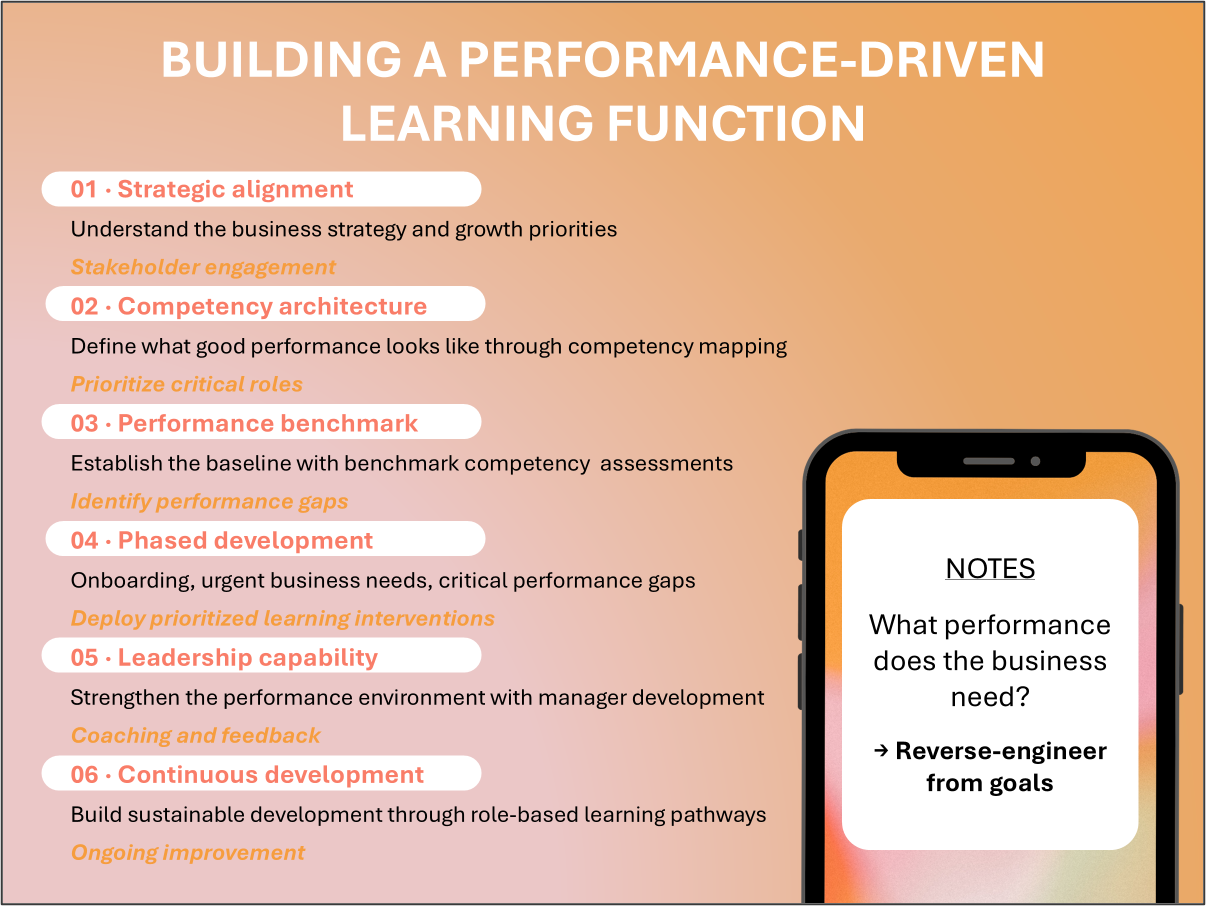
Here is what you should do, while maintaining the flexibility to do what most needs to get done on the path to getting there:
Understand the business. Start with the organization's strategy, objectives, structure and operating environment. Ask yourself, what’s the business plan and where is the business going? Understand what success looks like, what challenges are getting in the way and where developing people could make a meaningful difference. Reverse engineer from here.
Assess current capabilities and resources. Take stock of existing skills, competencies, leadership capabilities, learning resources, systems and processes. Understand what's working, what's missing and what can be leveraged rather than rebuilt. Build your competency framework to create role-based development pathways and conduct a baseline assessment to help with the next step!
Identify and prioritize opportunities. Determine the most important capability gaps and development opportunities. Consider business impact, urgency, feasibility and available resources. Decide what needs attention now, what can be addressed over time and what isn't a priority. Reach out to other business functions, what does HR, IT, or Compliance need support in?
Develop your strategy and roadmap. Establish the vision, objectives, priorities and operating model for your learning function (your Learning Strategy Blueprint). Determine what needs to be built, who needs to be involved, what resources are required and how you'll measure success.
Implement, evaluate and evolve. Start delivering against your priorities. Build the necessary infrastructure, programs and processes while monitoring results, gathering feedback and adjusting your approach as business needs evolve.
Learning is a support function, meant to make the business better, not an end of its own. That's why adaptability and agility are so important. Best practices exist, but it's more important to find, and implement, solutions that support business objectives. Your pace and prioritization must focus on doing what yields the most, and the best results, while never losing sight of your North Star.
The North Star is formalizing learning, to address the problems above in a long-term, systemic way. Learning takes time, effort, and resources, that can be challenging to find, but ultimately worth it for the long-term gain in performance and organizational capability.
Read about Competency Mapping and building your annual “enterprise training plan” or Learning Strategy Blueprint, next!