From tool literacy to measurable productivity.
Most AI training stops at the tool. It teaches people how to prompt, how to link apps, and how to build agents. And then it stops, leaving employees knowing how to use AI but unsure where to apply it, and leaving managers unsure how to reinforce it.
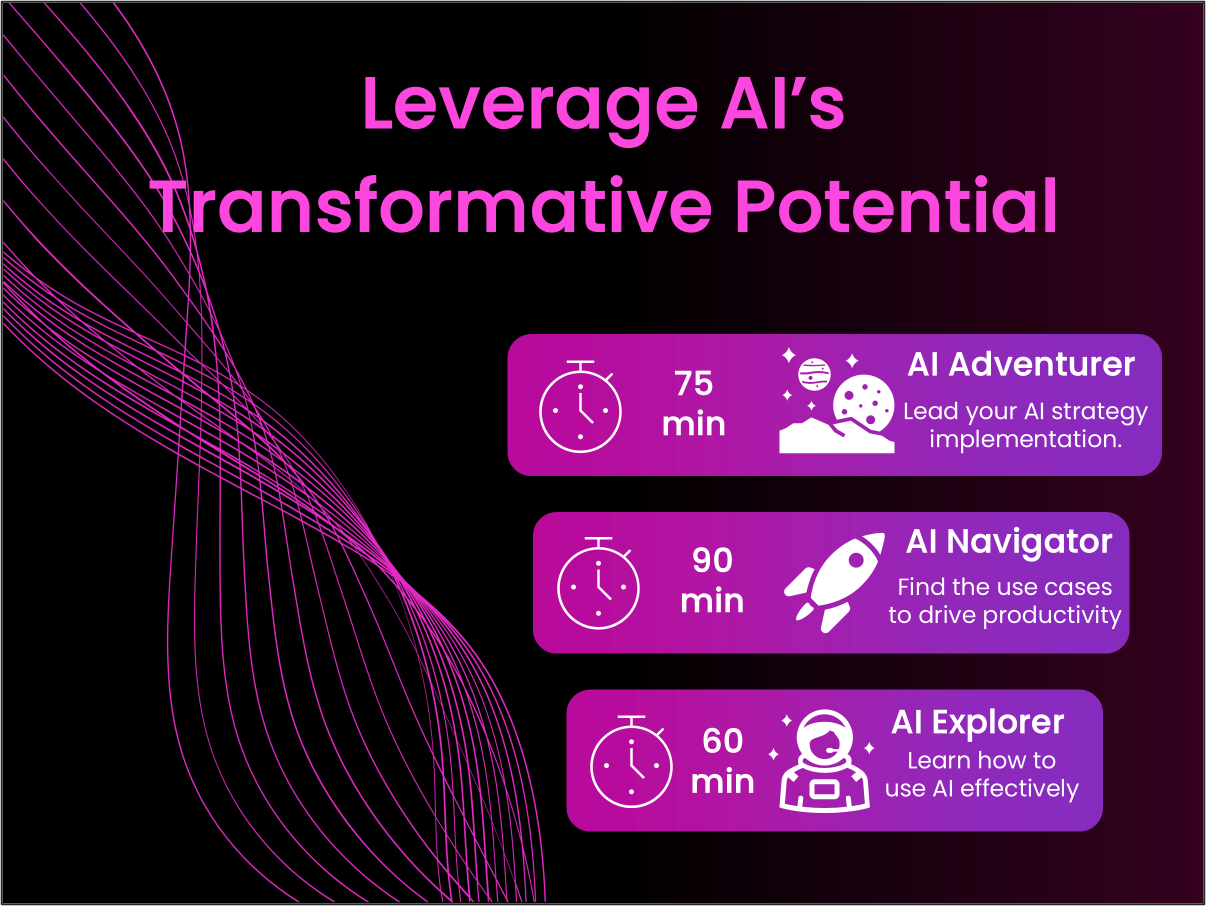
This program is designed differently. It’s a structured, progressive engagement that moves your team through three deliberate stages: learning the tool, finding the work, and leading the change.
It starts with the technology, but it ends with redesigned workflows, clear use cases, and managers who know how to sustain the gains. It is built on a rhythm of live sessions, independent application, and small-team pull-through, so the learning doesn't stay in the room; it changes how work gets done.
The 3-Stage Progression
Stage 1: AI Explorer (Tool Literacy)
The Goal: Establish baseline tool literacy and safe experimentation.
The Focus: You can’t redesign a workflow around a tool your team doesn’t understand. But we keep this phase tight. We cover the mechanics of the tool—prompting basics, capabilities, limitations, and guardrails.
What Happens: A 60-minute hands-on session, followed by a week of structured practice where individuals apply the tool to their own routine tasks.
The Shift: Your team moves from "I don't know how this works" to "I know how to use it, and I know what it can and can't do."
Stage 2: AI Navigator (Use Case Discovery)
The Goal: Translate tool capability into specific, role-level use cases.
The Focus: This is where we shift from the tool to the work. We don't ask for broad categories ("use AI for marketing"). We break down the actual tasks—the drafting, the summarizing, the analyzing—and find where AI genuinely improves speed or quality.
What Happens: A 90-minute discovery workshop, followed by 1–2 weeks of individual and small-team activities to map current workflows, identify specific use cases, and apply a prioritization lens (impact vs. effort).
The Shift: Your team moves from "we have a cool tool" to "here is exactly which tasks this tool will make better, and how we will measure it."
Stage 3: AI Adventurer (Change Leadership & Sustainment)
The Goal: Design the change management and reinforcement needed to make adoption stick.
The Focus: A use case isn't a strategy. Without workflow redesign, manager coaching, and psychological safety, people revert to old habits. This stage is about leading the change.
What Happens: A 75-minute strategy session to design the new rhythm, followed by 2–4 weeks of implementation support. We map how the use cases embed into daily work, how managers will observe and coach without micromanaging, and how to create safe spaces for experimentation.
The Shift: Leaders move from "hoping people use the tool" to actively driving a behavioral transformation with measurable metrics.
The Through-Line
If you only do Stage 1, you get shadow usage, People experimenting privately, with no shared learning and no measurable impact.
If you skip to Stage 3 without Stage 2, you get change management for the sake of change, without a clear target.
By moving deliberately from Tool → Work → Change, you solve the adoption problem at its root. The tool becomes the means. The redesigned work becomes the outcome. And the change management becomes the mechanism that makes it last.
The Rhythm
This isn't a one-day event. For effective AI adoption, you need to include:
Pre-work: Establishing baselines and gathering workflow context.
Live Sessions: The three anchor sessions (Explorer, Navigator, Adventurer).
Pull-Through Activities: Between-session assignments where individuals and small teams apply the concepts to real work.
Manager Enablement: Tools and coaching guides for leaders to reinforce adoption.
Final Artifacts: A prioritized use case library, AI-assisted workflow maps, and a measurement plan to track productivity gains.
View the program here.